House mice get into Baltimore homes through openings most people walk past every day. A mouse squeezes through a hole the size of a pencil — roughly a quarter inch — so the crumbling mortar joint at a Federal Hill…
House mice get into Baltimore homes through openings most people walk past every day. A mouse squeezes through a hole the size of a pencil — roughly a quarter inch — so the crumbling mortar joint at a Federal Hill basement window, the gap behind a Canton kitchen addition's sill plate, the unsealed gas or water penetration under a Hampden sink, and the worn threshold on a Highlandtown alley door are all doors as far as a mouse is concerned. Rats need a bigger opening, which is why a home can be rat-free and still have mice. In Bolton Hill and Mount Vernon, shared party walls in tall brick rows let mice travel between addresses inside the wall cavity, so activity often shows up in one unit while the nest sits behind the neighbor's cabinets. Roland Park's stone foundations and mature plantings give mice cover right up to the wall line; Charles Village and Locust Point rows tend to show first activity in basements and under stairs. Heating season, roughly October through March, is when call volume climbs across Baltimore City — mice move toward warmth and stored food, not standing water, which is part of why they are found upstairs far more often than rats are.
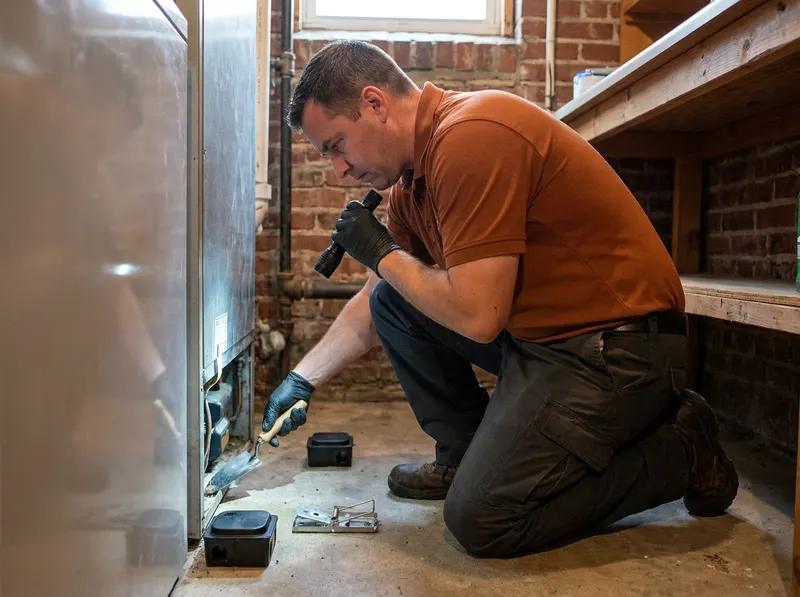
The evidence tells us which service fits. Droppings the size and shape of black rice grains, shredded paper or insulation in a drawer, greasy smudge lines along a baseboard, and gnawed cardboard in a pantry point to house mice. Larger capsule-shaped droppings, half-inch-wide burrows in an alley bed, or gnawed wood at ground level point to rats and a different treatment plan. Bringing that distinction to the phone helps: mouse work is interior-heavy trapping plus precision sealing, while rat work leans on exterior burrow treatment and heavier exclusion hardware. If you have children or pets, snap traps inside enclosed boxes and locked stations placed in voids they cannot reach are the standard approach, and the technician will tell you exactly where every device sits before leaving.
A single trapping visit fits a home with one clear entry point and light, recent activity — a few droppings under the sink after a basement door was left propped. A multi-visit program fits Fells Point and Canton rentals, houses with a finished basement, or any address where droppings appear in more than one room, because mice breed fast enough that removing the current population without closing the openings just resets the clock. Sealing is the part that decides whether the problem ends. Door sweeps, copper mesh and sealant at pipe collars, repointed mortar at grade, and screened crawl or dryer vents cost more up front than another round of bait and are the reason the second call does not happen. Find the source. Seal the home.
For landlords and small property managers handling turnover between tenants, the useful sequence is inspection before the unit is cleaned, trapping while it is vacant, then sealing documented with the gap locations noted so the next tenant's complaint can be answered with a record. Multi-unit buildings are quoted per unit plus common areas, since a hallway trash room or shared basement usually feeds every apartment above it.
Every job gets a firm, written price after a free on-site visit.
Tell us about your mouse control (house mice) job in Baltimore and we'll send a clear, written quote — usually the same day.
 Zenvora Pest Control Service