Zenvora Pest Control ServiceZenvora Pest Control Service

Rat Control (Norway Rats)

Norway rats leave evidence a homeowner can verify without a flashlight lecture. Droppings are blunt-ended and roughly three-quarters of an inch — noticeably bigger than the rice-grain pellets a mouse leaves. Burrow…
Call (667) 309-5173 →(667) 309-5173
Rat Control (Norway Rats) in Baltimore, MD
Quick answer
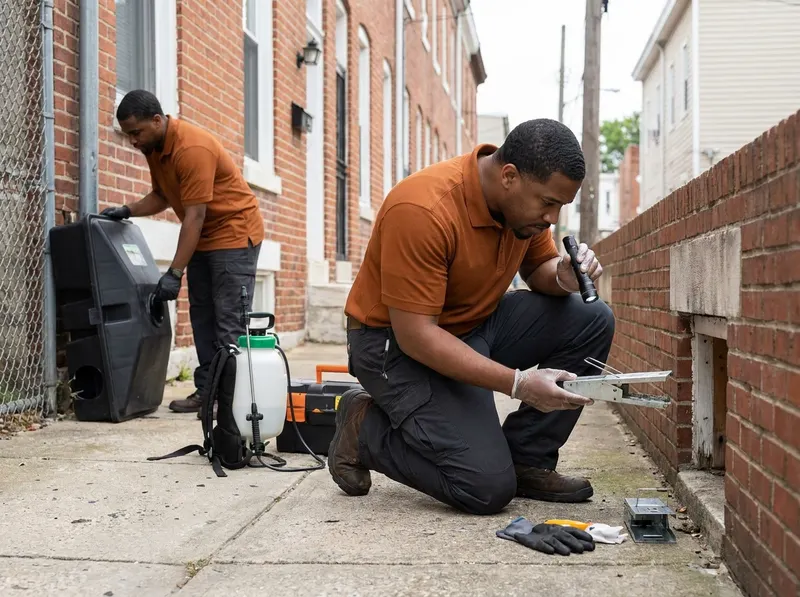
  • What's included: a walk of the property perimeter, alley pad and basement; burrow counting and mapping; tamper-resistant exterior bait stations or snap-trap sets; interior trapping where activity is confirmed; and a written list of entry gaps that need sealing.
  • How fast: most Baltimore rat calls are scheduled within 24-72 hours, and knockdown on an active exterior colony typically takes 2-4 weeks of follow-up visits rather than one appointment.
  • What it costs: Norway rat work in Baltimore starts at $250 and commonly runs $250-$900 for treatment; exclusion and sealing work is quoted separately, usually $350-$1,200 depending on how many openings exist.
  • What we take: cash, card, and check are standard for residential rat work; landlords and small property managers can be invoiced per address.
  • How to book: call (667) 309-5173 and describe what you are seeing — droppings, gnawed trash bags, a hole in the alley dirt — and the inspection is scheduled at no charge.

Norway rats leave evidence a homeowner can verify without a flashlight lecture. Droppings are blunt-ended and roughly three-quarters of an inch — noticeably bigger than the rice-grain pellets a mouse leaves. Burrow openings are two to four inches across, usually within a few feet of a foundation wall, a shed skirt, an alley trash pad, or the soft dirt behind a Formstone-fronted row home. Along interior joists and basement walls you will see dark rub marks where oily fur has polished the wood. A Norway rat only needs a gap about a half-inch wide to squeeze through, which is why loose basement door sweeps, unscreened crawl vents, and the annular gap around a water service line all count as doors.

Baltimore's rear alley grid is what makes this a different job than suburban rodent work. Row homes in Canton, Highlandtown and Fells Point share party walls and a common alley where trash sits, so a colony feeding on one block's cans travels under three or four properties. Treating only your side of the wall moves the problem sideways. That is the reason the inspection walks the alley pad and the neighboring grade line, not just your basement, and it is the reason many residents also file a 311 report so the city's abatement crews are working the public right-of-way while private treatment handles the property itself. Older sections of the city carry a second route most homeowners never consider: clay sewer laterals. Norway rats swim, and a cracked lateral or an open floor-drain trap in a Bolton Hill or Mount Vernon basement can deliver rats from the sewer straight into a finished room with no exterior entry at all.

Choose rat-specific service over general mouse control when the droppings are large, the gnaw damage is coarse, you hear heavy movement rather than light scratching, or you can find a burrow hole outside. Mouse programs lean on dozens of small interior placements; Norway rat programs live or die on exterior burrow work and physical exclusion. The honest trade-off is timeline and cost: a rat job is rarely one visit, and sealing gaps with hardware cloth, mortar and steel is labor you cannot skip if you want the result to hold past the first cold snap. Homes backing onto green space — Patterson Park, Druid Hill Park, the Gwynns Falls/Leakin Park edge — see steadier outside pressure, so those properties usually need a maintained exterior perimeter rather than a one-time cleanout.

Safety questions get answered before anything is placed. Exterior rodenticide, when it is used at all, goes into locked tamper-resistant stations anchored where a dog, a toddler, or a backyard chicken cannot reach the bait. Inside occupied living space, trapping is the default. Gardens, raised beds and pet runs get flagged during the walkthrough so placements stay away from them. Note that Baltimore City is an independent city, not part of Baltimore County, so alley ownership, trash-pad rules and abatement contacts differ from a Towson or Dundalk address — the inspection accounts for which jurisdiction the property sits in. Find the source, seal the home: that order matters, and reversing it is why store-bought traps and bombs keep failing on these blocks.

What it costs

Inspection and burrow mapping (row home or single family)No charge with scheduled service
Initial Norway rat treatment, single-family or row home$250 - $450
Multi-visit rat program (initial plus 2-3 follow-ups)$450 - $900
Exterior alley and burrow baiting with locked stations$250 - $550
Exclusion and sealing of entry gaps (per home, by opening count)$350 - $1,200
Landlord turnover or multi-unit row-home rat cleanout$600 - $1,500+
Ongoing exterior rodent perimeter (monthly or quarterly)From $250

Every job gets a firm, written price after a free on-site visit.

Common questions

How much does Norway rat control cost in Baltimore?
Norway rat service in Baltimore starts at a $250 minimum and commonly lands between $250 and $900 for treatment across the first few visits, with sealing work quoted separately at roughly $350 to $1,200. Those are ballparks based on typical market range — the exact figure is confirmed during the free on-site inspection, once the burrow count and the number of open gaps are known.
Why do rats keep coming back to my Baltimore row home after I set traps?
Rats return because the burrow and the entry gap are still there. In Baltimore row-home blocks the colony usually nests in the shared rear alley — under a trash pad, a shed, or soft dirt against a foundation — so interior traps remove individual rats while the nest keeps producing replacements. Lasting control requires exterior burrow treatment plus physically sealing openings a half-inch or wider.
How do I tell a Norway rat from a mouse in a Baltimore basement?
Size of the droppings is the fastest tell. Norway rat droppings are blunt-ended and about three-quarters of an inch long, while house mouse droppings are pointed and closer to an eighth of an inch. Rats also leave coarse gnaw marks, greasy rub trails along basement walls, and two-to-four-inch burrow holes outside — Baltimore homeowners rarely find burrows with a mouse problem.
Is rat treatment safe around children and pets in Baltimore homes?
Yes, when placement is controlled. Any exterior rodenticide is secured in locked tamper-resistant stations positioned out of reach of children and dogs, and interior work in occupied Baltimore homes defaults to trapping rather than loose bait. Gardens, pet runs and play areas are identified during the walkthrough and kept clear.
Can rats get into a Baltimore house through the sewer line?
They can. Norway rats swim, and older Baltimore neighborhoods such as Mount Vernon, Bolton Hill and Federal Hill still have clay sewer laterals that crack with age. A broken lateral or a dried-out basement floor-drain trap lets rats enter with no visible exterior hole, which is why the inspection includes drains, cleanouts and the base of the waste stack.

Ready to get started?

Tell us about your rat control (norway rats) job in Baltimore and we'll send a clear, written quote — usually the same day.